
The Obligation to the Stranger
The Obligation to the Stranger
One of the things I've noticed over the years is that some of the most important questions about environments don't appear until you're the outsider.
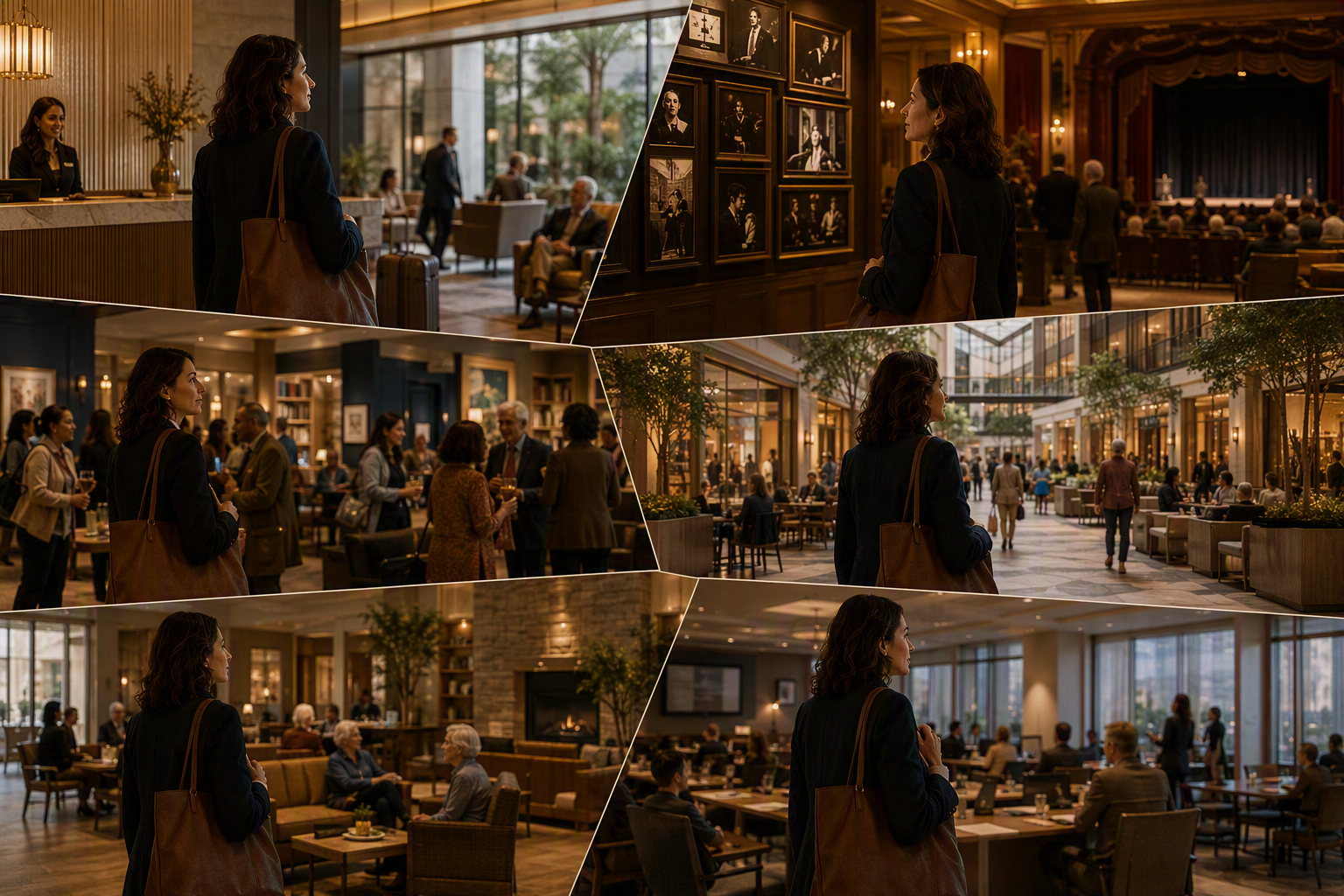
It doesn't matter whether it's a hotel after a long day of travel, a conference in a building you've never visited before, a community event where everyone else seems to know one another, or an assisted-living community you're visiting for the first time. The details change, but the experience is remarkably consistent. You step through the door and immediately begin looking for clues. Where am I supposed to go? Is this the right entrance? How does this place work? If I need help, where do I find it? Most of us don't consciously narrate those questions to ourselves, but we ask them all the same. And whether it's intentional or not, the environment begins answering them the moment we arrive.
What fascinates me is how much attention organizations devote to relationships after they form. Hotels work hard to recognize returning guests. Membership organizations invest in engagement and retention. Retail environments build loyalty programs. Assisted-living communities create continuity with residents and families. Community organizations spend years cultivating a sense of belonging. All of that matters. Relationships are valuable, and environments that support them well create experiences people remember. Yet the more I thought about it, the more I realized that every one of those relationships begins at exactly the same point.
They begin with a stranger.
Before someone becomes a loyal guest, they are simply a traveler standing in a lobby after midnight. Before someone becomes a valued member of a community, they are a first-time attendee trying to understand how participation works. Before someone feels a sense of belonging, they are often quietly wondering whether they belong at all. The environment may know almost nothing about them. It may never see them again. Yet the environment still has responsibilities toward them. That realization became increasingly important to me as I spent more time thinking about Human Trust and the role environments play in creating it.
One of the reasons this matters is that modern technology has become remarkably good at recognizing people. Membership systems know who's returning. Loyalty programs remember preferences. Reservation systems maintain histories. Applications personalize experiences. Intelligent Homes learn routines and adapt to the people living within them. Many of these capabilities are genuinely useful. The challenge appears when environments begin designing primarily for the people they already know. Once that happens, unfamiliar visitors quietly become edge cases.
The guest who doesn't know where to park becomes an exception. The newcomer trying to determine whether participation is welcome becomes an exception. The visitor unsure which entrance they should use becomes an exception. The family member who feels uncomfortable asking questions becomes an exception. In most cases, nobody intended for that to happen. Quite often, the people responsible for the environment simply understand it so well that they've forgotten what it feels like to encounter it for the first time.
That's one of the reasons I believe strangers are so important.
Strangers reveal whether an environment is truly understandable or merely familiar to the people who already know how it works.
The more I studied shared environments, the more I noticed an interesting imbalance. The environment almost always knows more than the person entering it. The hotel knows which rooms are available, where services are located, and how the property is organized. The community organization understands its customs and expectations. The assisted-living facility knows visitation procedures, support resources, and operational boundaries. The mixed-use development understands how buildings, entrances, destinations, and services are connected. The visitor usually knows almost none of those things.
That's where governance begins to feel much more human than procedural.
The question isn't simply whether rules exist. The question is what the environment does with the knowledge it possesses. Does it make expectations visible? Does it explain itself? Does it help people understand how to participate? Does it provide orientation before confusion turns into frustration? Over time, I've come to a simple conclusion. A person shouldn't have to earn basic dignity through familiarity. Clarity shouldn't require membership. Orientation shouldn't be reserved for repeat visitors. Respect shouldn't depend upon loyalty status. The ability to understand where you are and how to participate should exist before a relationship has formed.
That insight changed the way I think about trust.
We often associate trust with personalization. An environment remembers something useful about us. A service adapts to our preferences. A system anticipates a need before we express it. Those experiences can absolutely strengthen trust. But I no longer believe they create the foundation of trust. The foundation appears much earlier.
Trust begins when a first-time hotel guest can find their room without feeling lost. Trust begins when a visitor immediately understands where help is available. Trust begins when a delivery provider can complete their task without becoming an obstacle. Trust begins when a family member feels welcome while visiting someone they care about. Trust begins when a newcomer can participate without feeling excluded. None of those experiences require personalization. They require consideration. The environment behaves as though the stranger matters.
The more I reflect on this, the more I find myself returning to a simple question that sits beneath almost every governance discussion.
Who are we designing for?
When we design only for the people we already understand, blind spots inevitably appear. The environment becomes optimized for familiarity and increasingly difficult for outsiders to navigate. But when we intentionally design for people we haven't met yet, something changes. Expectations become clearer. Responsibilities become easier to discover. Boundaries become more understandable. The environment explains itself instead of assuming prior knowledge. In a strange way, the stranger becomes one of the most important participants in the design process despite never being present in the room.
Perhaps that's why I've come to think about hospitality differently.
The more time I spend studying shared environments, the less I believe hospitality belongs exclusively to hotels. Hospitality appears whenever an environment helps an unfamiliar person succeed. I've seen it in retail spaces. I've seen it in community organizations. I've seen it in mixed-use developments, assisted-living communities, membership organizations, cultural venues, and countless other shared environments. Hospitality isn't merely service. It's the ability of an environment to help someone understand where they are, what matters, and how to participate with dignity.
And that's ultimately why the stranger matters so much.
Environments don't begin with relationships.
Relationships come later.
They begin with people who don't yet know whether they belong.
Human Trust begins before personalization. Before an environment remembers us, adapts to us, or anticipates our needs, it has an opportunity to answer a much simpler question: when a stranger arrives, does the environment behave as though that person matters?
That's where trust begins.