A luxury hotel lobby with guests at reception — the hospitality context for the BehavesWell Framework

Contexts — Hospitality

Hospitality

Hotels, resorts, and lodging environments that serve guests across every moment of their stay — from arrival to departure and everything in between.

The Hospitality Context

Where Strangers Become Guests

Hospitality environments are among the most demanding contexts for intelligent spatial behavior. A hotel lobby must simultaneously welcome a first-time leisure traveler, a road-weary business guest, a family navigating with children, and a local resident using the bar — each with different needs, different rhythms, and different expectations of the space.

The BehavesWell Framework identifies hospitality as a primary context because it concentrates nearly every challenge of shared-space design: anonymity, transience, emotional variability, cultural diversity, and the obligation to serve people the space has never met before.

The Range of Occupants

Every Guest Arrives Differently

A hospitality environment does not get to choose who walks through its doors. On any given morning, the same lobby receives a first-time visitor who has never stayed in a hotel of this type, a returning guest who knows exactly where everything is, a business traveler moving on four hours of sleep, a family with young children managing competing needs, and a local resident who uses the restaurant as a neighborhood anchor.

It also receives people under stress — navigating a difficult transition, recovering from a disrupted journey, managing a health situation, or simply unfamiliar with the conventions the space assumes. These occupants are not edge cases. They are the full range.

A hospitality environment behaves well when it reduces uncertainty without requiring prior familiarity — when the space itself communicates what is available, where to go, and how to ask for help, regardless of whether the guest has been here before or knows the conventions of the category.

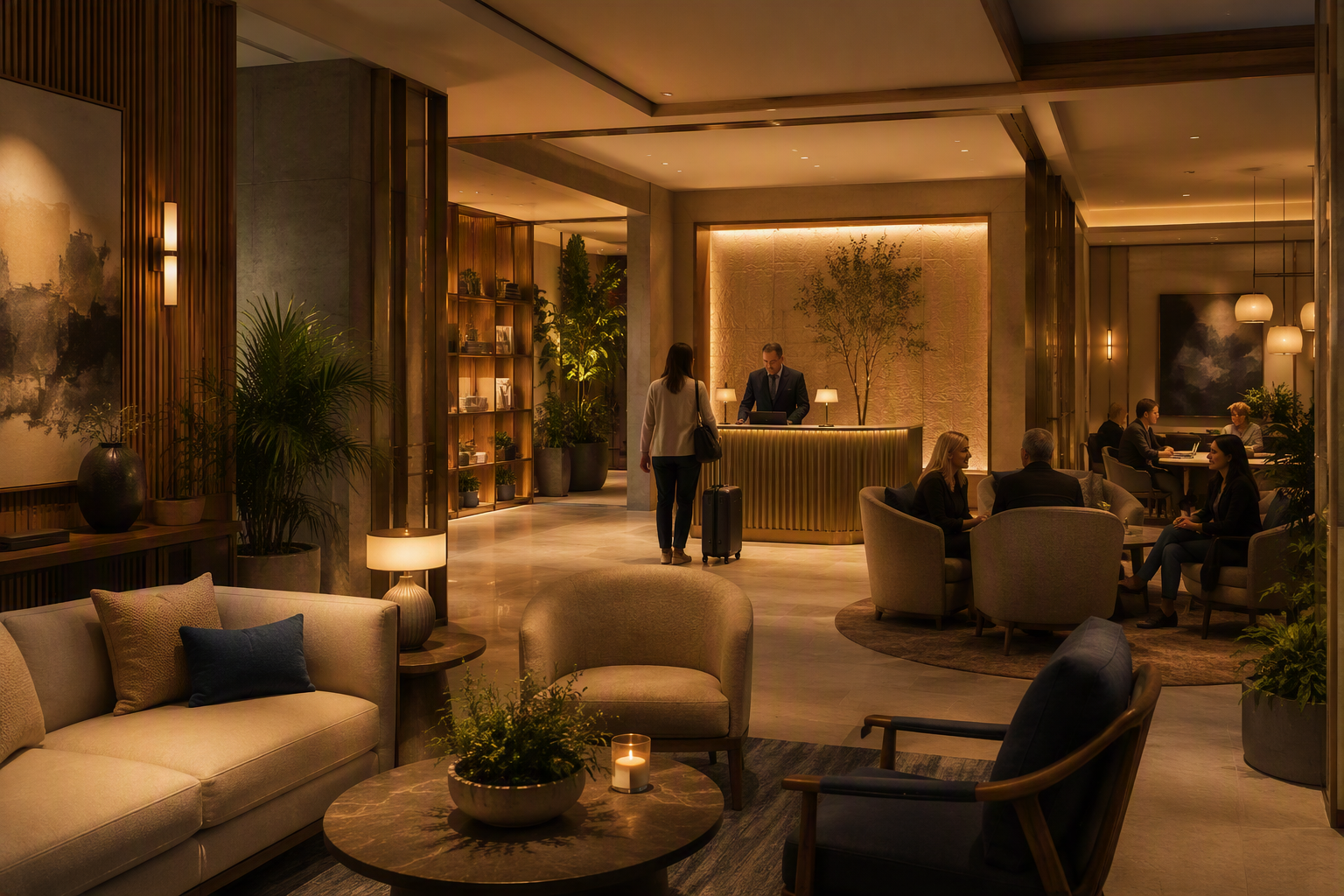
A hotel lobby with guests of different types — business travelers, families, and first-time visitors sharing the same environment

The same lobby, the same moment — first-time visitors, returning guests, business travelers, families, and people under stress, each navigating the space with different needs and different prior knowledge.

Framework Application

How the Framework Applies

Arrival as Orientation

The first moments in a hospitality space set the behavioral contract. Spaces that behave well signal their logic immediately — where to go, what is available, and how the environment will respond.

Ambient Legibility

Guests should be able to read the space without staff intervention. Wayfinding, service cues, and environmental signals must communicate clearly across language and familiarity barriers.

Graceful Transitions

From lobby to corridor, from restaurant to pool, from public to private — hospitality spaces require seamless behavioral transitions that feel natural rather than managed.

Recovery by Design

When something goes wrong — a delay, a noise complaint, a service failure — the space itself should support recovery. Behavioral design anticipates friction and builds in resolution pathways.

Contextual Learning Journey

Learn Through Hospitality

Hospitality environments provide one of the clearest demonstrations of the BehavesWell Framework. Every guest arrives with different expectations, permissions, preferences, needs, and levels of familiarity. This 11-episode journey explores the art of the possible when hospitality technology, service, architecture, and accountability are considered together from the beginning.

Framework Focus — Human Trust

How Can a Hotel Behave Well Toward Guests It Has Never Met?

Hospitality begins with unfamiliarity. A first-time visitor, returning guest, business traveler, family, event attendee, local dining guest, and service provider may enter the same environment with completely different expectations and needs. This episode introduces the central question: how can a hotel earn Human Trust before familiarity exists?

Framework Focus — Coordination

What Is Required to Make a Hotel Behave Well?

A hotel cannot earn trust through mobile apps, key cards, room systems, restaurants, housekeeping, amenities, and guest services operating independently. This episode explores the integration, coordination, orchestration, shared context, and accountability required to make the property behave as one coherent hospitality environment.

Framework Focus — Truth

How Does a Hotel Know What Is True?

Is the room actually ready? Is the lounge open? Is the fitness center available? Has the maintenance issue been resolved? This episode explores how authoritative facts establish the shared reality on which every guest-facing service, communication, and decision depends.

Framework Focus — Identity

How Does a Hotel Know Who the Guest Is?

A person may be a registered guest, returning guest, member of a traveling party, conference attendee, restaurant patron, employee, vendor, or day visitor. This episode explores how the environment establishes relevant Identity without confusing recognition with permission or requiring intrusive identification.

Framework Focus — Operational Trust

How Does a Hotel Know What the Guest Is Allowed to Access?

A recognized guest may have room access but not concierge-lounge, health-club, spa, backstage, event, or resident-only access. This episode separates knowing who a person is from determining what that person may appropriately access or do in the current context.

Framework Focus — Stewardship

Who Is Responsible When Hospitality Fails?

Room readiness, privacy, maintenance, accessibility, dining, amenities, service recovery, and guest communication may belong to different accountable caretakers. This episode explores how obligations reach the correct person or team without turning every issue into noise for the entire operation.

Framework Focus — Continuity

What Should a Hotel Remember After Checkout?

Which room, accessibility, dining, and service preferences should follow a returning guest? Which temporary permissions should expire? What should never be retained? This episode explores useful Continuity without unnecessary retention, surveillance, or inappropriate familiarity.

Framework Focus — Concierge

What Should the Hotel Do Next?

Once the hotel understands reality, Identity, permission, responsibility, and context, the environment can offer appropriate assistance. This episode explores how service may reduce friction, anticipate reasonable needs, and coordinate the next action without becoming presumptive or acting beyond authority.

Framework Focus — Explainability and Auditability

Why Did the Hotel Do That?

Guests and operators should be able to understand what the environment observed, what context mattered, what decision was made, what action followed, and what outcome occurred. This episode applies the Explanation Chain to hospitality so behavior remains visible, reviewable, and accountable.

Framework Focus — Governance

How Does a Hotel Change Without Breaking the Guest Experience?

Hotels evolve through renovations, new vendors, system replacements, policy changes, service redesigns, and changing operators. This episode explores how governance preserves intended guest outcomes, privacy boundaries, accountability, and behavioral consistency while allowing safe change.

Framework Focus — Technical Debt

Can a Hotel Accumulate Technical Debt?

Disconnected systems, overlapping Identity models, outdated access rules, undocumented exceptions, orphaned integrations, and accumulated workarounds slowly erode the experience envisioned at the beginning. This episode examines how architectural discipline and governance preserve clarity, maintainability, and Human Trust over time.

Episodes will be linked here as they are produced. Subscribe to the Research Journal to be notified when new content is available.

Research Status

Formal findings for the Hospitality context are still in development. The active research agenda is organized around seven behavioral dimensions: trust formation on arrival, spatial orientation without prior familiarity, identity legibility across guest types, transition management between zones and service modes, appropriate disclosure of service constraints, recovery pathways when service fails, and the conditions under which assistance feels helpful rather than intrusive. Observations and early patterns will be published in the Research Journal as the work develops.

Research Journal