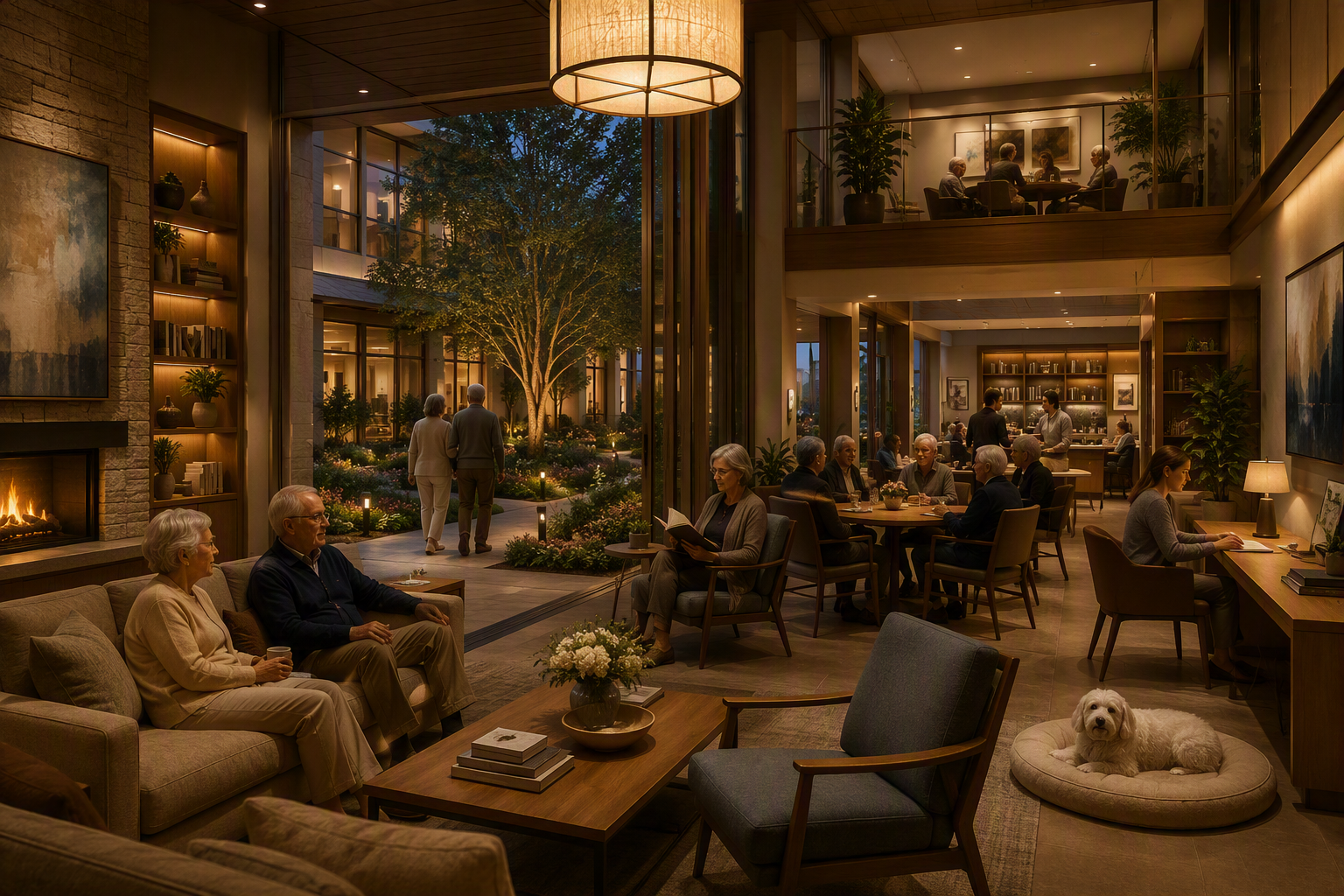
A warm, dignified assisted living common area — the assisted living context for the BehavesWell Framework

Contexts — Assisted Living

Assisted Living

Residential care environments that serve people navigating dependency, dignity, and the need for both safety and autonomy — often simultaneously.

The Assisted Living Context

Where Dignity Is the Design Brief

Assisted living environments carry the highest behavioral stakes of any context in the BehavesWell Framework. The people they serve are often navigating loss — of independence, of familiar surroundings, of cognitive certainty — and the space must respond to that reality with intelligence and care.

The framework identifies assisted living as a context where the gap between what a space signals and what a resident needs can have profound consequences. Environments that behave well in this context do not merely accommodate disability — they actively support personhood.

Framework Application

How the Framework Applies

Autonomy Preservation

Spaces that behave well in assisted living maximize the range of independent choices available to residents — through layout, wayfinding, and environmental cues that support self-directed movement and decision-making.

Cognitive Legibility

For residents with cognitive impairment, environmental clarity is not a convenience — it is a clinical necessity. Spaces must communicate their logic through multiple redundant channels: spatial, visual, tactile, and temporal.

Relational Infrastructure

Assisted living environments must support the relationships that sustain residents: with family, with staff, with peers. The space should create natural conditions for connection rather than isolating people in their rooms.

Graceful Monitoring

Safety monitoring is necessary but must be implemented in ways that do not make residents feel surveilled or infantilized. Behavioral design finds the balance between protection and dignity.

Contextual Learning Journey

Learn Through Assisted Living

Assisted-living environments challenge every element of intelligent behavior through questions of dignity, autonomy, continuity, care, privacy, shared stewardship, monitoring, and trust. This 11-episode journey explores what becomes possible when technology supports the person rather than managing the person.

Framework Focus — Human Trust

How Can an Assisted-Living Environment Support Without Taking Control?

Assistance becomes harmful when support displaces agency, dignity, privacy, or personhood. This episode introduces the central question: how can an intelligent environment provide meaningful support while ensuring that the resident remains the person at the center of every decision?

Framework Focus — Coordination

What Is Required to Make an Assisted-Living Environment Behave Well?

Resident preferences, care plans, family relationships, staff workflows, meals, facilities, accessibility, activities, monitoring, and emergency processes must work together rather than compete. This episode explores the integration, coordination, and orchestration required to support independence and appropriate care.

Framework Focus — Truth

How Does an Assisted-Living Environment Know What Is True?

What is the resident's current context? Has support already been provided? Is an environmental condition normal? Is a reminder still relevant? This episode explores how accurate, current, and authoritative facts protect both dignity and appropriate assistance.

Framework Focus — Identity

How Does an Assisted-Living Environment Know Who Is Engaging?

The relevant person may be a resident, family member, visitor, caregiver, clinician, service provider, staff member, or emergency responder. This episode explores Identity as a relationship to the resident and environment rather than a simple recognition event.

Framework Focus — Operational Trust

How Does an Assisted-Living Environment Know What Is Allowed?

Recognition does not automatically authorize access to private information, monitoring, room entry, care records, or intervention. This episode explores how permission, consent, policy, context, urgency, and resident authority govern appropriate behavior.

Framework Focus — Stewardship

Who Shares Responsibility Without Displacing the Resident?

Residents, families, staff, operators, care providers, facilities teams, and service partners may share different obligations. This episode explores how stewardship remains accountable and coordinated without turning the resident into an object of administration.

Framework Focus — Continuity

What Should an Assisted-Living Environment Remember?

Routines, preferences, relationships, accessibility needs, personal vocabulary, and established patterns may support independence and familiarity. This episode explores what should persist, who may use it, and how continuity can support the person without becoming surveillance.

Framework Focus — Concierge

What Should the Assisted-Living Environment Do Next?

The appropriate next step may be to assist, ask, remind, redirect privately, notify a caretaker, or remain silent. This episode explores how Concierge can reduce friction and support daily life without eroding agency or acting beyond authority.

Framework Focus — Explainability and Auditability

Why Did the Assisted-Living Environment Intervene?

Residents and authorized caretakers should be able to understand what was observed, why an intervention occurred, who was notified, what action followed, and what outcome resulted. This episode explores traceability as a requirement for accountable support.

Framework Focus — Governance

How Does an Assisted-Living Environment Evolve Without Losing Dignity?

Policies, staff, vendors, monitoring systems, resident needs, and care practices change over time. This episode explores how governance protects consent, dignity, autonomy, privacy, and accountability as the environment evolves.

Framework Focus — Technical Debt

Can an Assisted-Living Environment Accumulate Technical Debt?

Legacy monitoring, disconnected care systems, duplicated records, undocumented escalation rules, inconsistent resident profiles, and accumulated exceptions create hidden risk and administrative burden. This episode examines how technical debt can quietly undermine dignity, support, and trust.

Episodes will be linked here as they are produced. Subscribe to the Research Journal to be notified when new content is available.

Research Status

Detailed case studies, pattern libraries, and evidence reviews for the Assisted Living context are in active development. Subscribe to the Research Journal to be notified when new findings are published.

Research Journal