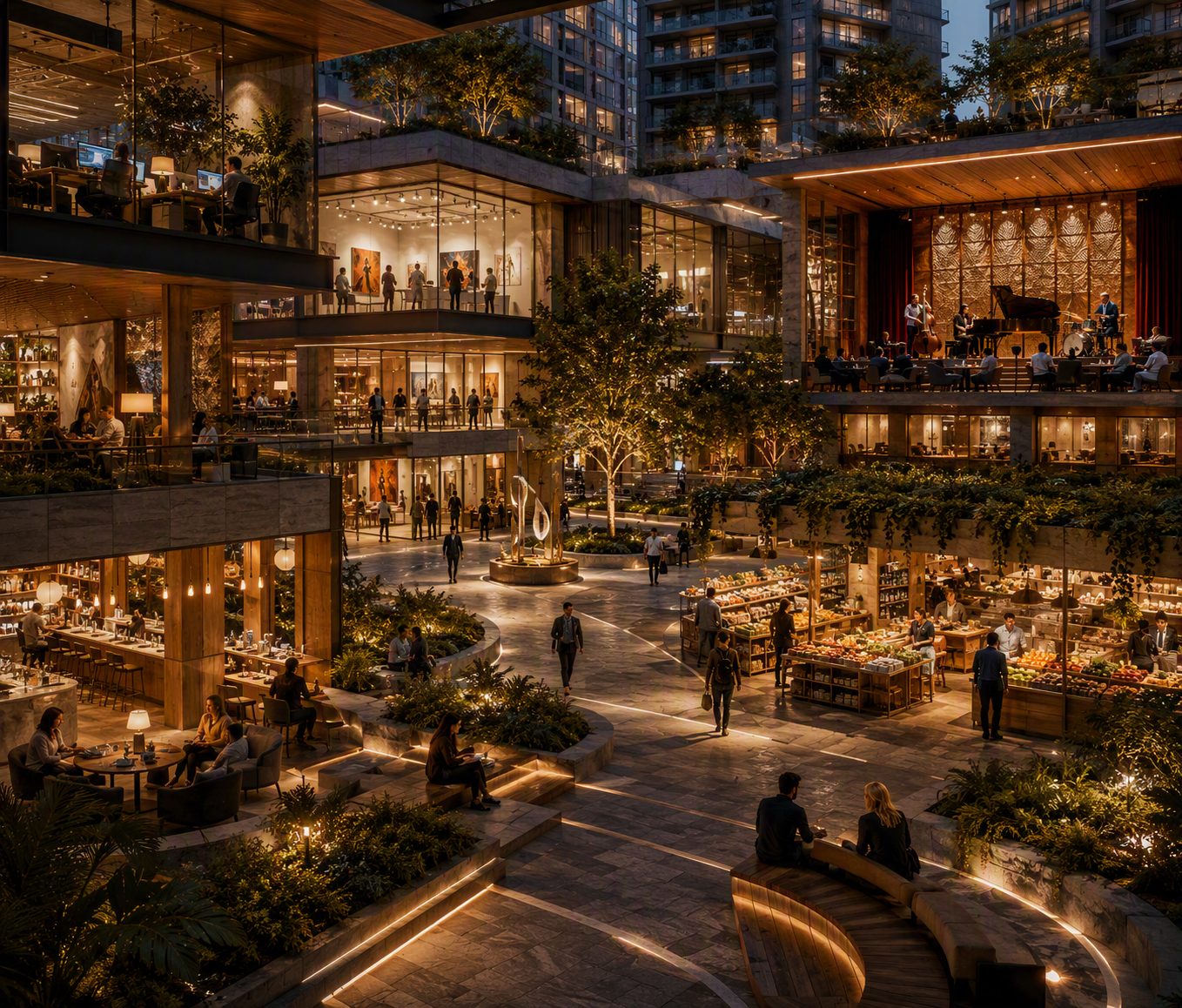
A vibrant mixed-use development where residential and commercial life share the same environment

Contexts — Mixed Use

Mixed Use

Developments where residential, commercial, and civic life share the same environment — requiring spaces that serve radically different people across the full arc of the day.

The Mixed Use Context

Where Lives Overlap

Mixed-use environments are among the most complex spatial challenges in the built world. A single lobby may serve a resident returning home, a visitor arriving for a meeting, a delivery worker, a café customer, and a child heading to school — all within the same hour.

The BehavesWell Framework treats mixed-use as a context that demands layered behavioral intelligence: spaces must shift their character across time of day, user type, and social context without requiring explicit reconfiguration.

Framework Application

How the Framework Applies

Temporal Layering

Mixed-use spaces serve different populations at different times. Behavioral design must account for morning commuters, midday visitors, evening residents, and late-night workers — each with distinct needs and expectations.

Identity Legibility

In environments that serve multiple functions, people need to quickly understand which parts of the space are for them. Clear behavioral cues prevent confusion without requiring signage that fragments the environment.

Threshold Management

The transitions between public and private, commercial and residential, active and quiet are the most behaviorally sensitive moments in mixed-use design. These thresholds require careful spatial choreography.

Conflict Absorption

When different user groups have incompatible needs — noise levels, pace, territorial expectations — the space itself must absorb and mediate that conflict rather than leaving it to individuals to resolve.

Contextual Learning Journey

Learn Through Mixed Use

Mixed-use environments bring residents, visitors, workers, customers, students, vendors, service providers, and event attendees into one interconnected place. This 11-episode journey explores how technology and the BehavesWell Framework can coordinate overlapping spaces, identities, obligations, thresholds, and experiences.

Framework Focus — Human Trust

How Can One Place Behave Well Toward So Many Different People?

A single lobby may be someone's front door, workplace entrance, delivery destination, meeting point, neighborhood café, or route to an event. This episode introduces the central mixed-use question: how can one environment earn Human Trust while meaning different things to different people at the same time?

Framework Focus — Coordination

What Is Required to Make a Mixed-Use Environment Behave Well?

Mixed-use developments combine residential, commercial, hospitality, retail, cultural, dining, parking, security, facilities, and public-space systems. This episode explores the integration, coordination, and orchestration required to make those independent operations feel like one coherent environment.

Framework Focus — Truth

How Does a Mixed-Use Environment Know What Is True?

Which entrance is open? Which area is public, private, tenant-only, resident-only, or temporarily restricted? Which service is available now? This episode explores how authoritative facts create a shared reality across changing uses, schedules, operators, and boundaries.

Framework Focus — Identity

How Does a Mixed-Use Environment Know Who Is Engaging?

A person may be a resident, employee, visitor, customer, delivery worker, contractor, event attendee, hotel guest, or service provider. This episode explores Identity as the relationship relevant to the current space, purpose, and moment rather than merely a person's name.

Framework Focus — Operational Trust

How Does a Mixed-Use Environment Know What Is Allowed?

Permissions may change as someone crosses from a public plaza into a residential lobby, office floor, hotel area, parking facility, event venue, or service corridor. This episode explores how Operational Trust governs access, disclosure, personalization, and action across changing thresholds.

Framework Focus — Stewardship

Who Is Responsible for Shared Space?

Owners, property managers, tenants, hospitality operators, facilities teams, security providers, vendors, resident associations, and public authorities may share responsibility. This episode explores how stewardship remains discoverable and accountable when ownership and operation overlap.

Framework Focus — Continuity

What Should Follow Someone Through a Mixed-Use Environment?

Should accessibility needs, permissions, wayfinding context, parking state, or service preferences follow someone across connected spaces? When should that context stop? This episode explores continuity across transitions without creating universal tracking or inappropriate persistence.

Framework Focus — Concierge

What Should the Mixed-Use Environment Do Next?

A coordinated environment may help someone navigate, transition between services, find the correct entrance, route a delivery, locate an event, or receive private assistance. This episode explores how proactive help remains context-aware, bounded, and appropriate.

Framework Focus — Explainability and Auditability

Why Did the Mixed-Use Environment Do That?

When multiple systems and operators contribute to an outcome, explanation becomes difficult. This episode explores how observations, context, policies, decisions, actions, notices, and outcomes remain traceable across organizational and spatial boundaries.

Framework Focus — Governance

How Do Multiple Operators Govern One Experience?

Mixed-use environments evolve through tenant changes, renovations, shifting public boundaries, new services, shared infrastructure, and policy updates. This episode explores how governance preserves coherent behavior when no single operator controls the entire experience.

Framework Focus — Technical Debt

Can a Mixed-Use Environment Accumulate Technical Debt?

Overlapping access systems, duplicate Identity stores, inconsistent room names, disconnected tenant platforms, undocumented thresholds, and inherited infrastructure create behavioral fragmentation. This episode examines how technical debt turns one place into many conflicting systems.

Episodes will be linked here as they are produced. Subscribe to the Research Journal to be notified when new content is available.

Research Status

Detailed case studies, pattern libraries, and evidence reviews for the Mixed Use context are in active development. Subscribe to the Research Journal to be notified when new findings are published.

Research Journal