
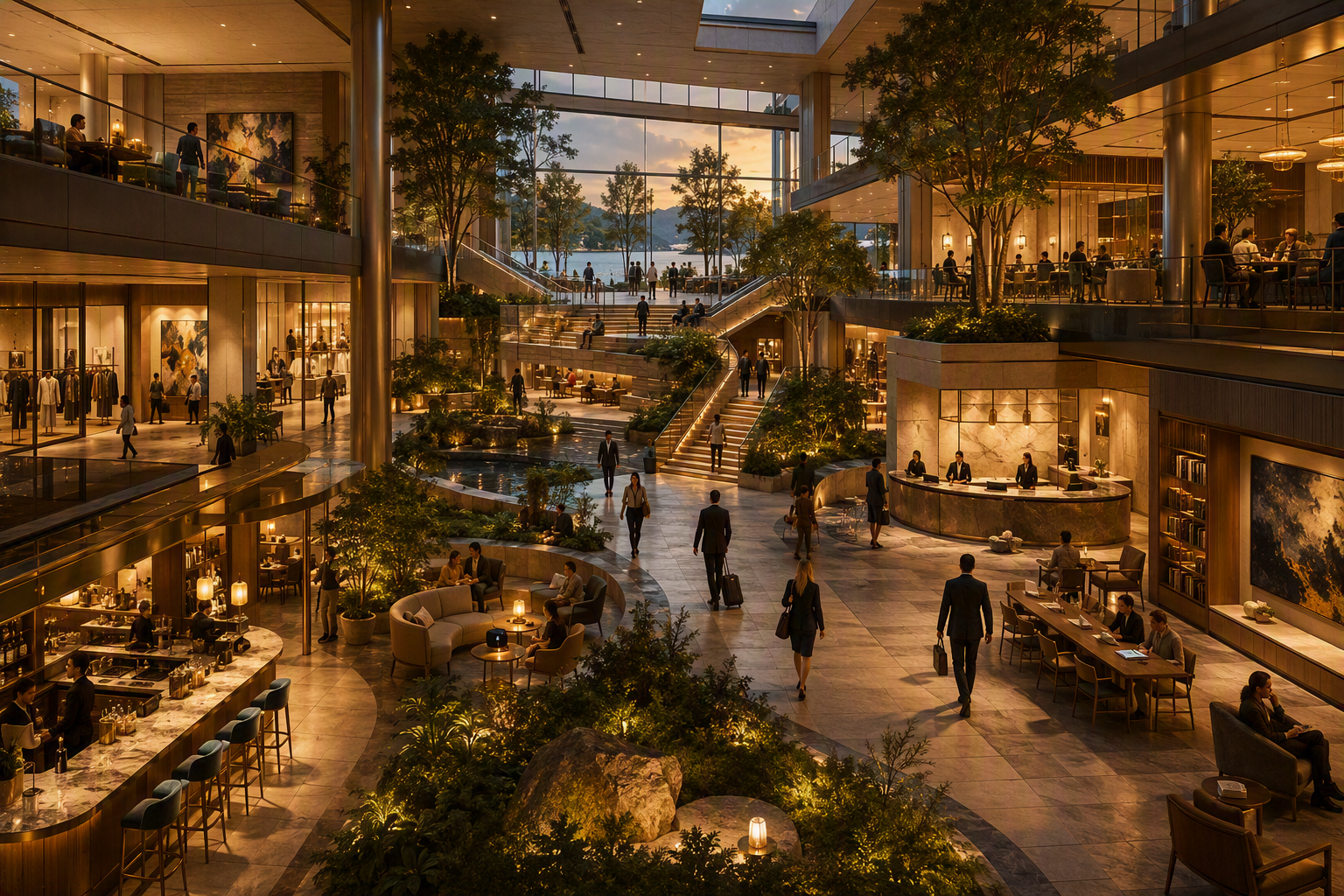
How Should a Space Behave When It Does Not Know You?
How Should a Space Behave When It Does Not Know You?
A few years ago, I started paying attention to something I'd experienced hundreds of times but rarely stopped to think about.
I would arrive somewhere unfamiliar, step through the door, and almost immediately begin looking for clues.
Sometimes it was a hotel after a long day of travel. Sometimes it was a restaurant I'd never visited before. Other times it was a community event, a mixed-use development, an office building, or a conference venue where I was meeting someone for the first time. The specifics changed, but the experience was remarkably consistent. Within seconds of crossing the threshold, I found myself trying to answer a series of questions I wasn't consciously asking.
Am I in the right place?
Where am I supposed to go next?
How does this place work?
If I need help, where do I find it?
Do I belong here?
Most of us don't think about those questions because we've become remarkably good at answering them. We read architectural cues. We observe how other people are behaving. We look for signs, pathways, reception desks, gathering spaces, elevators, and exits. We absorb information continuously, often without realizing we're doing it. Yet the more I paid attention to those moments, the more fascinated I became by how much they influenced the experience that followed. Long before I formed an opinion about the organization, the staff, the services, or even the purpose of the visit, I was already forming an opinion about the environment itself. I was deciding whether I trusted the space.
I don't mean trust in the cybersecurity sense or the contractual sense. I mean something much more human. Could I trust this place to help me succeed? Could I trust it to guide me when I was uncertain? Could I trust it not to leave me feeling lost, confused, or unwelcome? The answer often emerged within the first few minutes, and once I began noticing that pattern, I couldn't stop seeing it everywhere.
The more I thought about it, the more I realized that every shared environment eventually faces the same challenge. Not everyone who enters a space is the person the space was originally designed around. Hotels may be designed with an ideal guest in mind, but eventually a weary traveler arrives after a delayed flight, carrying luggage, frustrations, and very little patience. A retail space may have been designed for customers ready to buy, but many visitors are simply trying to learn. A mixed-use development may carefully distinguish between residents, workers, guests, vendors, and service providers, yet someone will always arrive who doesn't neatly fit those categories and simply wants to know where they're supposed to go.
You can see the same pattern in community organizations, assisted-living communities, entertainment venues, professional associations, places of worship, and countless other shared environments. An adult child visits a parent for the first time and doesn't know the facility. A guest attends an event where everyone else seems to know each other already. A visitor walks into a member organization and doesn't understand the customs, expectations, or social cues. The environment has never seen these people before. In some cases, it may never see them again. Yet the environment still has responsibilities toward them.
That realization reminded me of something I learned repeatedly during my years in technology. Systems are often designed around idealized users. The ideal customer. The ideal employee. The ideal resident. The ideal member. The ideal guest. The problem is that real life isn't populated by ideal users. Real people arrive carrying different expectations, different abilities, different experiences, different anxieties, and different levels of familiarity. Some walk in confidently. Others are quietly wondering whether they're in the right place. Some understand the rules. Others don't even know where to find them. A space that behaves well can't work only for the people it expected. It has to work for the people who actually arrive.
In fact, I've come to believe that strangers reveal more about an environment than its regular occupants ever can. Regular occupants already know how the place works. They've learned its shortcuts, adapted to its quirks, and compensated for its weaknesses. The unfamiliar visitor doesn't have that advantage. They encounter the environment exactly as it presents itself. Every confusing turn, every missing clue, every inaccessible service, every unnecessary point of friction becomes visible. The familiar user often masks an environment's weaknesses. The unfamiliar user exposes them.
As someone who has spent much of his professional life around technology, I've noticed that organizations often respond to these challenges in a predictable way. Someone suggests an app. Someone else proposes sensors, automation, digital assistants, artificial intelligence, reservation systems, access-control systems, or interactive kiosks. To be clear, I like technology. I've spent decades helping organizations deploy it, govern it, and create value from it. But I've also learned that technology can lead us toward the wrong question if we're not careful.
The question isn't, "What technology should we deploy?"
The question is, "How should the environment behave?"
That's a very different conversation. Once we ask it, we begin thinking about responsibility instead of features. We start considering what someone needs to know, how help should appear, when assistance is appropriate, and what kind of experience the space should provide for someone who has never been there before. Only after those questions are answered does technology become useful. Technology can support the behavior, but it shouldn't define it.
I often think about this through a simple thought experiment. Imagine arriving at a hotel you've never visited before. You know nothing about the layout. You don't know where the elevators are. You don't know where the restaurant is located. You don't know how the property is organized. In one version of the experience, every decision feels like a puzzle. Information is difficult to find. Signage is inconsistent. Assistance appears only after frustration has already set in. You eventually reach your destination, but the journey requires effort at every step. In another version, the environment seems determined to help you succeed. The pathways make sense. Clues appear where they're needed. Assistance is available without being intrusive. You still know very little about the hotel, yet somehow you feel confident navigating it. The difference isn't familiarity. The difference is behavior.
One environment is asking the guest to adapt to the space.
The other environment is helping the guest understand the space.
That distinction kept appearing everywhere I looked, regardless of industry. Eventually it led me toward a concept that became foundational within the BehavesWell Framework: Human Trust. Human Trust isn't a product, a platform, or a technology feature. It's an outcome. It emerges when people can reasonably rely on an environment, even when they have no prior experience with it. A visitor shouldn't need insider knowledge to navigate a building. A guest shouldn't need special instructions to understand where they belong. A community member shouldn't encounter unnecessary friction just to participate. A resident shouldn't worry that support will disappear the moment circumstances change. When an environment consistently helps people succeed, trust begins to develop naturally.
Not because the environment is perfect.
Because the environment behaves appropriately.
That's ultimately why Spaces That Behave Well exists. What fascinates me isn't any single solution. The answers may come from architecture, hospitality, operations, technology, governance, service design, or community practices. More likely, they'll emerge from combinations of all those disciplines working together. What interests me is careful observation. What patterns appear across hotels, restaurants, mixed-use developments, assisted-living communities, event spaces, and membership organizations? What responsibilities remain surprisingly consistent? What lessons transfer from one type of environment to another?
The more environments I encounter, the more I find myself returning to the same simple observation.
Most spaces become very good at serving the people they already understand.
The more interesting challenge is serving the people they don't.
And that continues to lead me back to the question at the heart of Spaces That Behave Well:
How should a space behave when it does not know you?
Not because we already have the answer.
Because asking the question reveals what Human Trust actually requires.